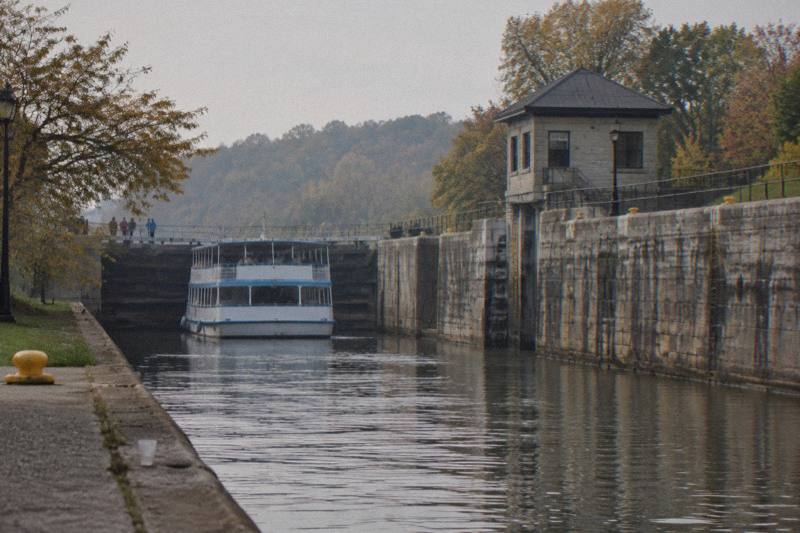
Do The Locks On The Erie Canal Still Work?
Yes, the Erie Canal's 35 locks still work every day of the navigation season. Here is which locks move boats, their hours, and which restored locks are heritage exhibits.
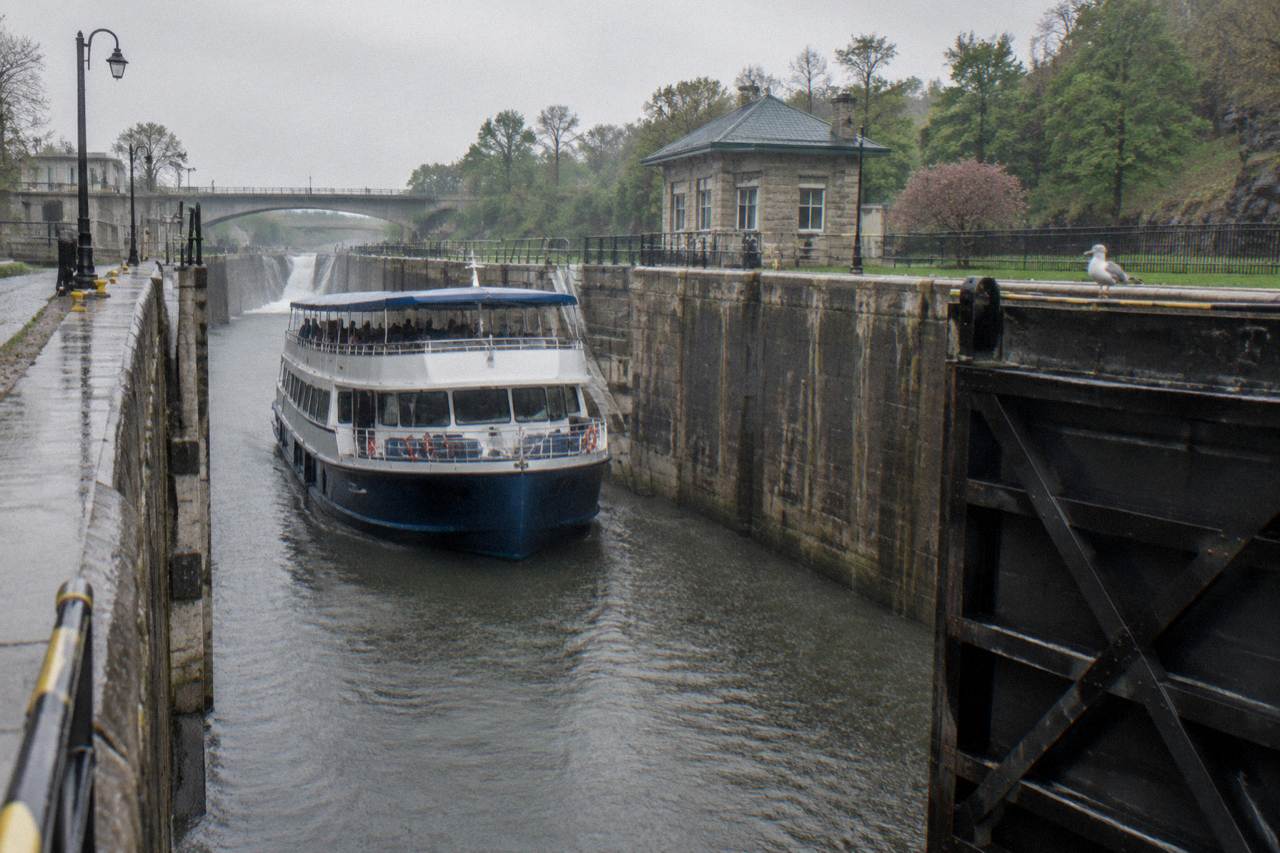
Do The Locks On The Erie Canal Still Work?
Yes. All 35 locks on the Erie Canal still work, and they operate every day of the navigation season, which in 2026 runs from Friday, May 15 to Wednesday, October 14. Locks are staffed from 8 a.m. to 6 p.m. daily, with extended hours to 9 p.m. at select locks in peak season. The state charges no tolls or fees for recreational use, so any boat may pass through a working lock for free. Once the season ends and the locks go quiet, the whole canal gets drained for winter, and why the Canal Corporation empties the Erie Canal each year explains how that process works.
The question sounds reasonable, because the canal is two centuries old and much of what people picture when they think of it, the stone Flight of Five at Lockport, the aqueducts, the 1825 opening ceremony, belongs to history. But the working waterway is a modern one. The Erie Canal today runs 338 miles from Waterford to Lake Erie, dredged 12 to 23 feet deep and 120 to 200 feet wide, with lock chambers 310 feet long, dimensions the original builders, who started work in Rome in 1817 and dug a 4-foot-deep, 40-foot-wide ditch with 90-foot locks, would not recognize (see Canal Depth Today). The locks that move boats today are the enlarged-canal chambers, and they run on schedule every season.
The scale of the engineering explains why the locks exist at all. Between Albany and Buffalo the canal climbs and drops a total of 571 feet, per the Erie Canalway fast-facts page, and every foot of that change happens inside a lock chamber. The original canal needed 83 locks to cover the same ground when it opened in 1825 after eight years of construction; the rebuilt channel needs 35, because each modern chamber is 310 feet long and handles far more water than the 90-foot originals. The state authorized the waterway on April 15, 1817, with a $7 million budget for a 363-mile route, and the final cost came in at $7,143,789. The canal that resulted, celebrated with the Seneca Chief's inaugural voyage and the Wedding of the Waters ceremony in 1825, was the seed of everything running today. If you're curious how much of that original waterway survives alongside the modern channel, the guide to what remains of the Erie Canal today covers the stretches you can still see and walk.
The New York State Canal Corporation confirms the operating picture on its boating hours page: standard lock and lift bridge hours are 8 a.m. to 6 p.m. daily, extended to 8 a.m. to 9 p.m. at select locations through the peak season. There are 57 locks across the entire state canal system, of which 35 sit on the Erie Canal itself, per the Erie Canalway National Heritage Corridor's locks page. Water levels and maintenance can change any given day, and the Canal Corporation posts notices for mariners on its alerts page, but the system as a whole functions.
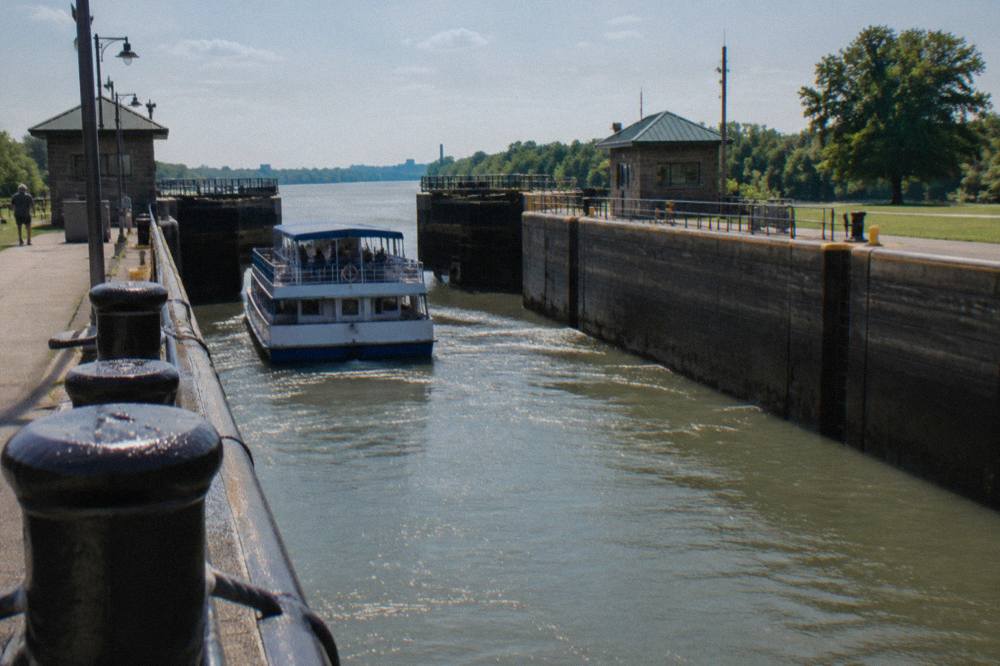
For most visitors the easiest way to see a lock actually work is not to bring a boat at all. It is to buy a ticket on a cruise that passes through one. Three operators on this roster run scheduled cruises through working locks, and the Lockport operator's 2-Hour Double Locks Cruise, from $26 per adult with a 4.8 rating across 865 reviews, has one of the two deepest review pools among them.
Which Locks Can You Ride Through On A Cruise?
Three working locks carry scheduled cruise passengers in 2026: Locks 34 and 35 at Lockport, Lock 32 at Pittsford, and Lock 18 at Jacksonburg near Herkimer. The Lockport cruise passes the double set, the Pittsford cruise runs through Lock 32, and the Herkimer cruise locks through Lock 18. All three run on published schedules between mid-May and mid-October.
The Lockport pair is the headline act. Locks 34 and 35 sit side by side at the Niagara Escarpment, and the operator, Lockport Locks & Erie Canal Cruises, calls them the only double set on the Erie Canal. Together the two chambers lift or lower a boat a combined 49.1 feet, 24.6 feet in Lock E-35 and 24.5 feet in Lock E-34, per the official canal guidebook. The operator's own materials round that to 50 feet, which is close enough for a sign but worth knowing the precise figure. The 2026 public cruise season runs May 11 to October 16, with daily 12:30 and 3:00 p.m. departures, a 10:00 a.m. sailing added daily from June 23 to September 6 and on Saturdays in spring and fall. The dock is at the Flight of Five, 210 Market Street, Lockport.
In Pittsford, the Sam Patch replica packet boat runs 90-minute cruises through Lock 32 from Sam Patch Dock at 12 Schoen Place. The listing carries a 4.4 rating across 180 reviews covering both Sam Patch products, and tickets run from $30 per adult, with seniors 65 and over and military at $28, students at $25, and children 3 and under free. The operator's season generally runs May to October, though it prints no confirmed 2026 date list, so the live schedule is the place to check. A lunch version, the Lock 32 Cruise With Lunch, adds a $23 meal to the $30 ticket for $53 per adult.
In the Mohawk Valley, Erie Canal Cruises operates the only canal cruise on this roster in that stretch of the state, a 90-minute trip through Lock 18 at Jacksonburg aboard a weather-protected vessel that sails rain or shine. It departs from Gems Along the Mohawk, 800 Mohawk Street, Herkimer, across from Thruway Exit 30. The 2026 season runs daily May 22 to October 12 at 1 p.m. and/or 3 p.m., with some days adding a 10:30 a.m. sailing. Tickets run from $29 per adult, children 4 to 12 at $20, military at $27, and age 3 and under free. The listing holds a 4.8 rating across 1,633 reviews.
If you want to compare every lock-passing option at once, the guide to which cruises go through a lock lays out the full field, including the Fairport cruises from Colonial Belle, whose 3-hour lock cruises run from $44 per adult through the Fairport lift bridge area.
When Are The Locks Open, And Do You Pay To Use Them?
Locks operate 8 a.m. to 6 p.m. daily through the season, with extended 8 a.m. to 9 p.m. hours at select locks during the peak period. Passing through costs nothing: the Canal System charges no tolls or fees for recreational use in 2026. Cruise passengers never handle lock fees at all, since the operator's ticket covers the trip.
The no-toll policy is worth underlining, because it is a genuine change from the canal's commercial heyday and from most toll waterways elsewhere. The Canal Corporation's boating information page states plainly that recreational use is free in 2026, and no altered policy has been posted. Private boaters still need to arrive during staffed hours, and one special case matters to anyone heading east: boaters must arrive at the Waterford Flight by 5 p.m. to lock through the full flight, per the Canal Corporation's own notice. More of these guides are collected on Erie Canal Boat Tours.
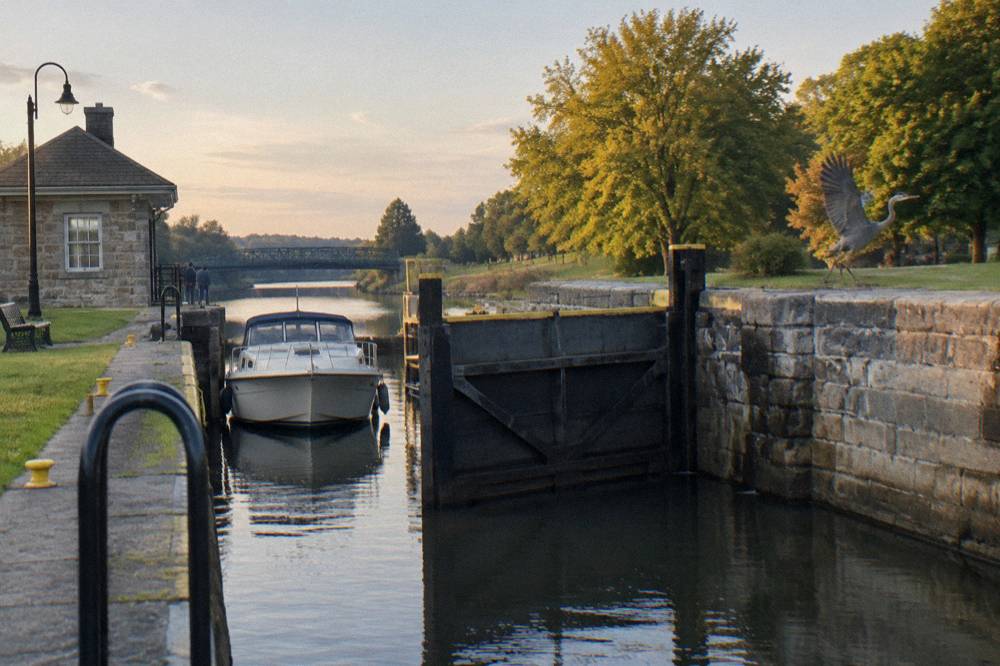
For cruise passengers the hours matter in a simpler way: they explain why departure times cluster in the early afternoon. A 12:30 or 1 p.m. departure keeps the boat comfortably inside the staffed window even with a two- or three-hour trip in front of it. Weather and water levels can still change a given day, so the operator's page is the final word on any single sailing.
The mechanics themselves have barely changed in principle since the 1825 canal opened. A boat enters an empty chamber, the gates close behind it, and water flows in or drains out until the level matches the next stretch of canal, at which point the far gates open (see Emptying The Canal). What has changed is the machinery and the scale: a 310-foot modern chamber moves a 100-foot tour boat the way the originals moved 70-foot packet freighters, and the staffed hours, free passage, and notice system are all managed by the Canal Corporation rather than the toll collectors of the canal's freight era.
| Lock | Location | Status | Who uses it |
|---|---|---|---|
| Lock E-34 and E-35 | Lockport | Working, combined 49.1 ft lift | Cruise boats and private vessels |
| Lock E-32 | Pittsford | Working | Sam Patch cruises and private vessels |
| Lock 18 | Jacksonburg | Working | Herkimer cruises and private vessels |
| Locks 69 and 70 (Flight of Five) | Lockport | Restored 1849 heritage locks, reopened 2014 | Visitors on foot, no boat passage |
The Flight Of Five: What Is Working And What Is History?
The Flight of Five at Lockport is the one place where the answer splits. The two modern chambers, Locks 34 and 35, are the working locks that raise and lower boats 49.1 feet. The restored 1849 locks beside them, Locks 69 and 70, reopened in 2014 as a heritage exhibit and carry no boat traffic. Both sit in the same Locks District, which is why the question comes up so often.
Visitors stand at the railing in Lockport and see two very different things at once. On one side, steel gates and concrete chambers fill and empty with tour boats and the occasional private vessel, the modern canal doing its job. On the other, the restored stone Flight of Five, the 1849 locks that once carried packet boats up the Niagara Escarpment in five short steps, sits dry and open to walkers, a museum piece you can read about at the free Locks District Museum, open 8 a.m. to 5 p.m. daily during canal season. The restoration of Locks 69 and 70 finished in 2014, and the Erie Canalway National Heritage Corridor lists the Flight of Five and the adjacent Discovery Center among Lockport's canal assets.
The distinction matters for planning. If the goal is to watch a lock work, stand at the modern chambers and wait for the next cruise boat, or better, be on it. The Lockport cruise from $26 per adult passes through both modern locks in about two hours, and the dock sits right at the Flight of Five, so the heritage locks are a short walk before or after sailing. The Erie Canal Discovery Center at 24 Church Street, admission $6 for adults with kids free alongside a parent, adds the historical layer, open 9 a.m. to 5 p.m. daily May through October. For the full story of the canal's past after your Lockport visit, the Erie Canal Museum in Syracuse guide covers hours, admission and what to see.
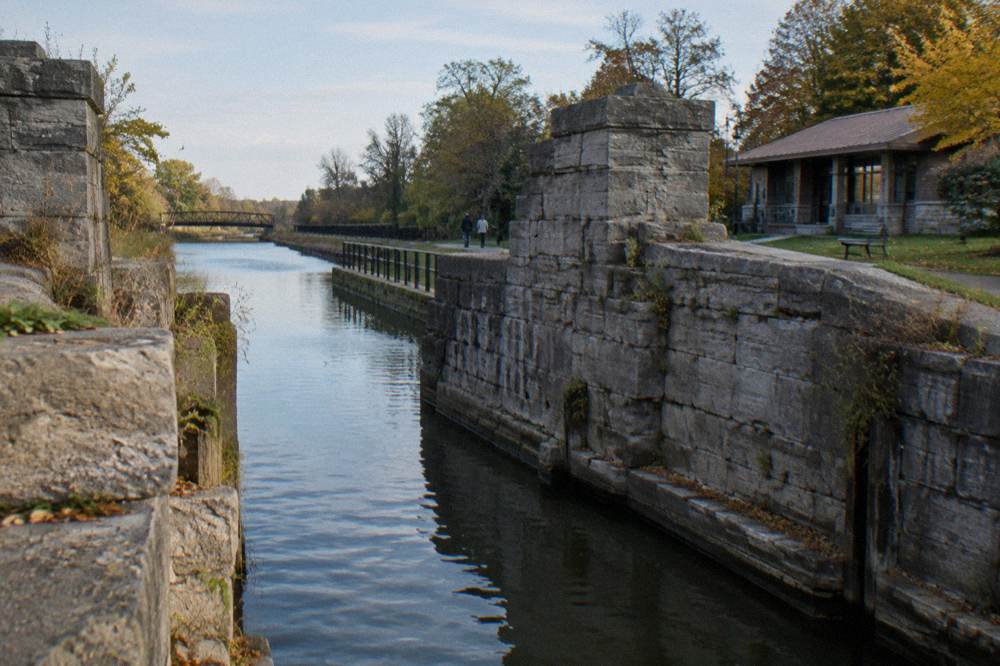
The same working-versus-heritage split shows up elsewhere along the canal, just less dramatically. The original 1825 canal had 83 locks; the modern Erie Canal needs only 35 because engineers rebuilt the channel deeper and straighter, cutting the route from 363 miles to 338 and replacing the old staircase of small chambers with fewer, far larger ones. Every lock a cruise passenger passes through today is an enlarged-canal structure doing the same job the 1825 locks were built for, which is the honest one-line answer to the question this page asks. If you want the full picture of the waterway those locks sit on, the mile-by-mile length of the Erie Canal traces the route from Albany to Buffalo and explains how the rebuilding years changed the distance.
Why The Locks Still Matter
The locks still work because the canal still carries commercial and recreational traffic and because the state staffs and maintains them as a functioning waterway, not a monument. Roughly 3.2 million people live in the heritage corridor, and the canal's 524-mile system ties dozens of canal-side towns to a working lock schedule every summer. Without operating locks, the cruises, the boat rentals, and the canal towns' waterfront season would all stop.
That is not an abstraction. The whole cruise economy described on this site, from the Lockport double locks to the Sam Patch runs through Lock 32, depends on lock operators showing up each morning from mid-May to mid-October. The self-skippered canal boat rentals from Erie Canal Adventures, from $2,770 per private boat for a 3-night charter on a 34-foot Lockmaster, put ordinary travelers through working locks on their own, after an orientation and training session at the Macedon base, and the rate includes fuel, tolls, and full equipment. The canals close to boats after October 14, which is why every operator's season ends in mid-to-late October.
The institutional backing runs deeper than one season. Congress established the Erie Canalway National Heritage Corridor in 2000, covering 524 miles of waterway, 4,834 square miles, and 23 counties, and the National Park Service and the Canal Corporation jointly promote the corridor as a living system. The 2025 bicentennial, with its bicentennial program announced in 2024 and the "Raising More Voices" theme, treated the canal as an active asset rather than an anniversary of something finished. The locks are the proof: a monument does not publish lock hours, post notices to mariners, or employ lock operators through a 202nd consecutive season.
For travelers, the practical takeaway is simple. The locks work, the season is long, and the cheapest seat in the house is a cruise ticket, with the Lockport option carrying a deep pool of 865 reviews and the Herkimer cruise holding the largest review count on this roster. Pick a date inside the season window, book through the operator's live listing, and the lock does the rest.
Common Questions About The Erie Canal Locks
Do The Locks On The Erie Canal Still Work?
Yes. All 35 locks on the Erie Canal operate through the navigation season, May 15 to October 14 in 2026, staffed from 8 a.m. to 6 p.m. daily with extended 9 p.m. hours at select locks in peak season. Several of them, including the Lockport double set, Lock 32 at Pittsford, and Lock 18 at Herkimer, carry scheduled cruise passengers.
Are the Flight of Five locks at Lockport working locks?
No. The restored 1849 locks, Locks 69 and 70, reopened in 2014 as a heritage exhibit and carry no boats. The working locks at Lockport are the modern chambers, Locks 34 and 35, which together lift boats 49.1 feet and pass the Lockport cruise twice per trip.
Do you have to pay to go through a lock on the Erie Canal?
No. The Canal System charges no tolls or fees for recreational use in 2026, so private boaters lock through free during staffed hours. Cruise passengers pay only their ticket price; the operator handles the waterway.
Which cruises actually pass through a working lock?
The Lockport Double Locks Cruise through Locks 34 and 35, the Sam Patch cruise through Lock 32 at Pittsford, the Herkimer cruise through Lock 18, and Colonial Belle's 3-hour lock cruises from Fairport. The Colonial Belle 2-hour afternoon cruise and Sunday brunch cruise pass no lock.
When do the locks stop working each year?
The navigation season closes to boats on October 14, 2026. After that the locks stop operating until the following May. Some cruise operators run slightly different windows, such as Lockport's May 11 to October 16 public schedule and Colonial Belle's season to October 30, so check the operator's page for a specific sailing.