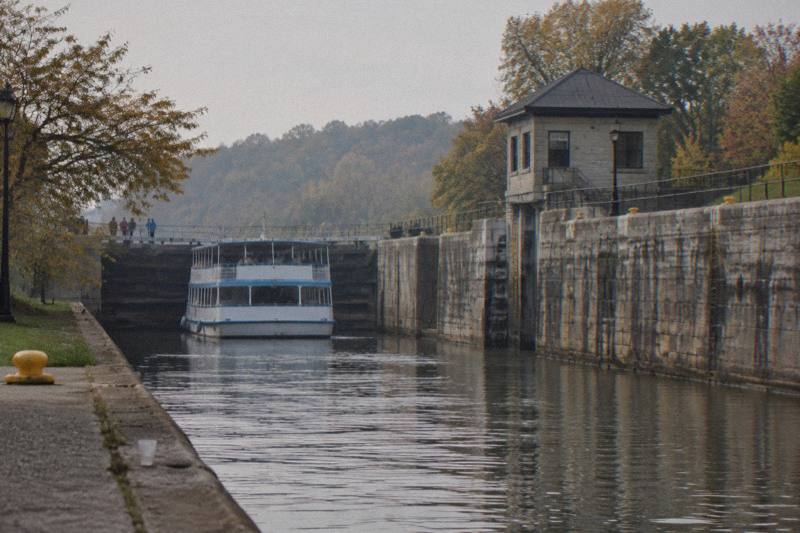
Does Any Part Of The Erie Canal Still Exist?
Yes, most of it. The Erie Canal of today is 338 miles of working waterway, and original stonework survives in restored locks like Lockport's Flight of Five.
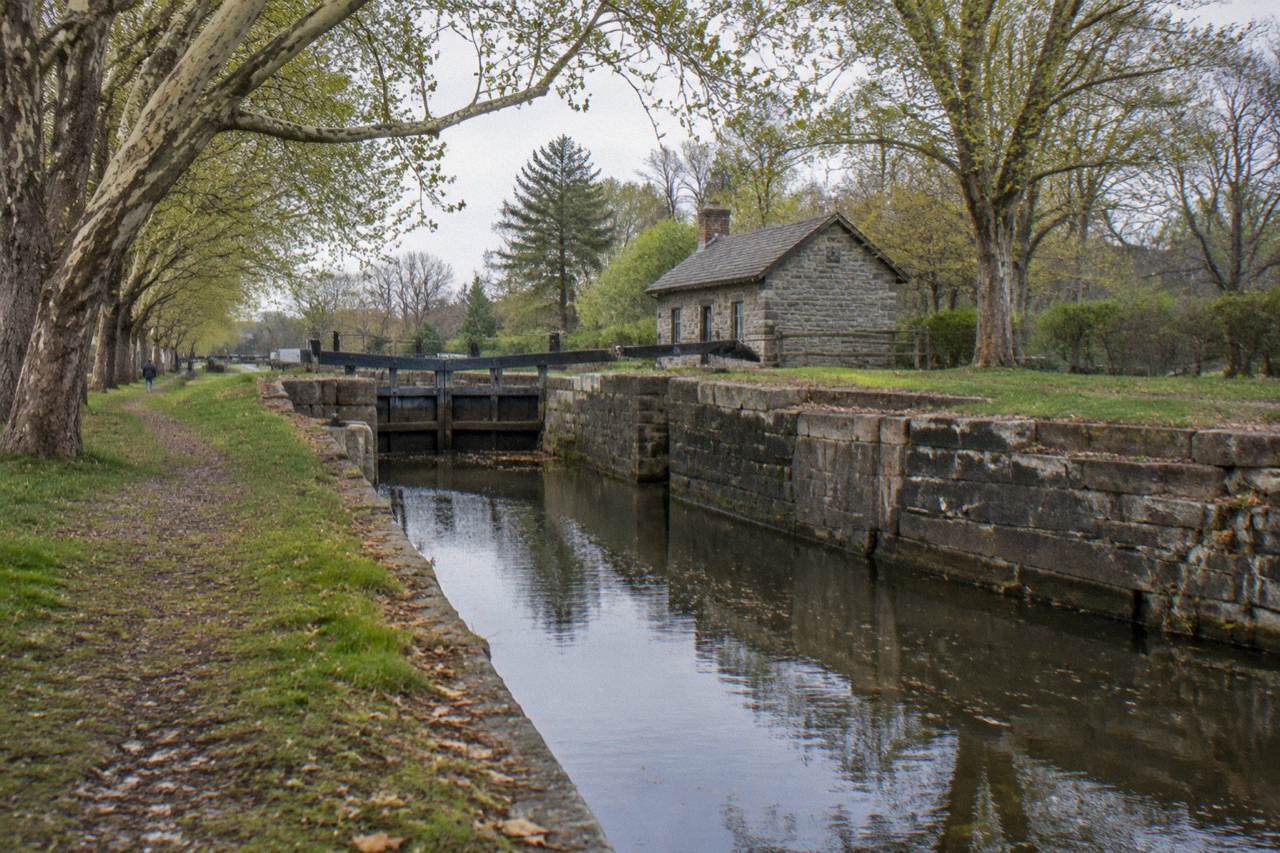
The Erie Canal did not vanish, it was rebuilt in place. The waterway that opened in 1825 after eight years of construction is still a working canal, now 338 miles from Waterford to Lake Erie, and boats lock through it every day of the navigation season. The original channel was 4 feet deep and 40 feet wide; the canal of today runs 12 to 23 feet deep and 120 to 200 feet wide. In a handful of places, most famously Lockport's Flight of Five, the original stone locks still stand beside the modern ones. If you'd rather see the locks working than just read about them, our guide to the best spots to watch Erie Canal locks in action covers where to stand and what you'll see.
Does Any Part Of The Erie Canal Still Exist?
Yes, and not just fragments. The Erie Canal exists today as a 338-mile working waterway from Waterford to Lake Erie, kept open by the New York State Canal Corporation from May 15 to October 14 in 2026, the 202nd consecutive season. Much of the modern channel follows and enlarges the original 1825 route, and pieces of the first canal survive as restored locks, most notably the Flight of Five at Lockport.
The short answer hides a longer story. The canal that opened in 1825 was 363 miles long, dug by hand and horse power to a depth of 4 feet and a width of 40 feet, with 83 locks just 90 feet long. It cost $7,143,789 and was authorized on April 15, 1817, with construction starting that year in Rome. That channel proved too small almost immediately, and the state enlarged it more than once, first to a wider and deeper version and later into the Barge Canal shape it holds now: locks 310 feet long, a channel 12 to 23 feet deep, and a straightened route that measures 338 miles, according to the Erie Canalway's canal today page.
So when people ask whether any part still exists, the honest answer is that most of it does, in the way a widened road still follows the original survey. The alignment survived. The dimensions did not. And in a few special places the original stonework survived too, because the enlargement built a new channel next to the old one rather than over it.
That distinction matters for travelers. A cruise boat on the canal today is floating on the successor of the 1825 ditch, through locks that do the same job the first 83 did, raising and lowering boats across a 571-foot elevation change between Albany and Buffalo. The Flight of Five at Lockport, where the old locks sit restored alongside the working pair, is the one place where you can see both eras in a single glance.
The scale of the system around that single canal also survives. The Erie Canal is the trunk of a New York State canal system with 57 locks in total, 35 of them on the Erie itself, and the whole network sits inside a National Heritage Corridor that Congress established in 2000, spanning 524 miles of waterway, 23 counties and 3.2 million residents. That is a lot of institutional weight for a "dead" canal, and it exists precisely because the waterway never stopped being used.
Three cruises on this waterway make the point in different ways. The 2-Hour Lockport Double Locks Cruise passes the only double set of locks on the Erie Canal, Locks 34 and 35, right beside the restored Flight of Five, from $26 per adult. The 90-Minute Pittsford Lock 32 Cruise runs through a working lock in the Rochester suburbs, from $30. The 90-Minute Mohawk Valley Lock 18 Cruise from Herkimer covers the same story from $29. Each one travels a canal that is simultaneously two centuries old and thoroughly modern.
How Much Of The Original 1825 Canal Survives?
The original dimensions survive nowhere in active use: no boat today floats in a 4-foot-deep, 40-foot-wide channel with 90-foot locks. What survives is the route, the name, and a small number of original structures, led by Lockport's Flight of Five, whose restored locks 69 and 70 date from 1849 and reopened to visitors in 2014. The modern canal is an enlargement, not a rebuild on a new line.
The enlargement history explains the pattern. When the state deepened and widened the canal, engineers frequently cut the new channel parallel to the old one, leaving the first ditch drained or repurposed. In Lockport the change was vertical as well as lateral: the modern Locks 34 and 35 handle the Niagara Escarpment in two giant steps, with a combined lift the official guidebook puts at 49.1 feet, E35 at 24.6 feet and E34 at 24.5 feet. The cruise operator rounds that to 50 feet in its own materials, a small discrepancy worth knowing before you hear a narration. The old Flight of Five, five smaller locks that did the same climb in stages, stands beside them.
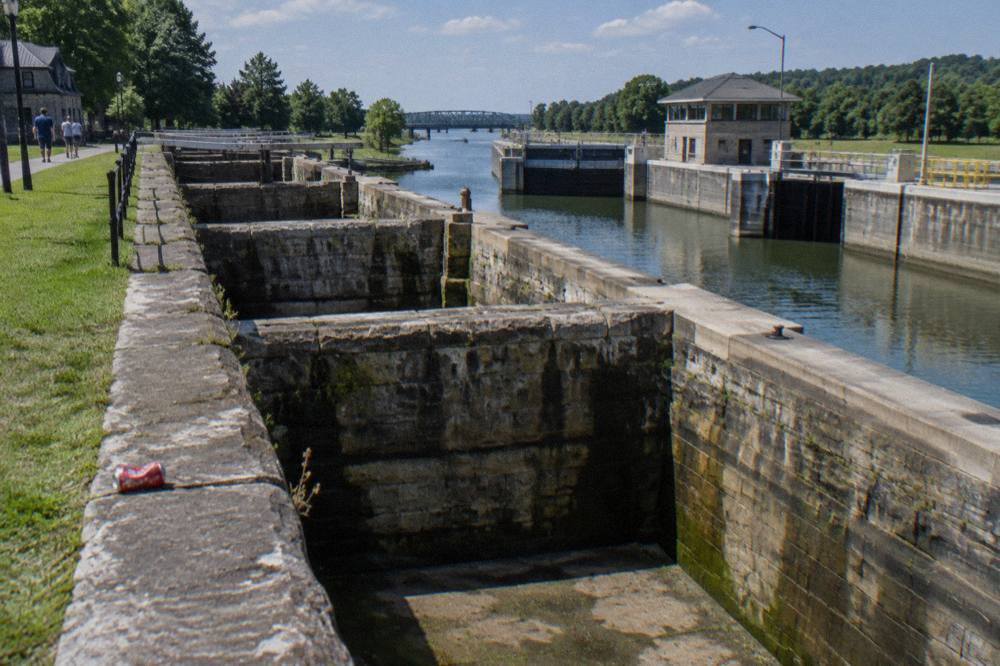
The table below puts the two canals side by side. Every figure comes from the official fast-facts and history pages of the Canal Corporation and the Erie Canalway National Heritage Corridor.
| Feature | Original canal (1825) | Canal today |
|---|---|---|
| Length | 363 miles | 338 miles, Waterford to Lake Erie |
| Depth | 4 feet | 12 to 23 feet |
| Width | 40 feet | 120 to 200 feet |
| Locks | 83, each 90 feet long | 35 on the Erie Canal, 310 feet long |
| Elevation change | 571 feet, Albany to Buffalo | Same 571 feet |
| Cost | $7,143,789 | Maintained by the NYS Canal Corporation |
| Opened | 1825, after eight years of construction | 2026 season May 15 to October 14 |
Two numbers in that table surprise people. The canal is shorter now than it was, because the enlargements straightened curves out of the route. And the lock count fell from 83 to 35 because bigger locks could do in one chamber what small ones once needed several to do. The 571 feet of elevation change never moved; only the machinery for climbing it changed. The Canal Corporation's history page covers the 1817 authorization and the 1825 opening, including the Seneca Chief's ceremonial Wedding of the Waters voyage that poured Lake Erie water into New York Harbor.
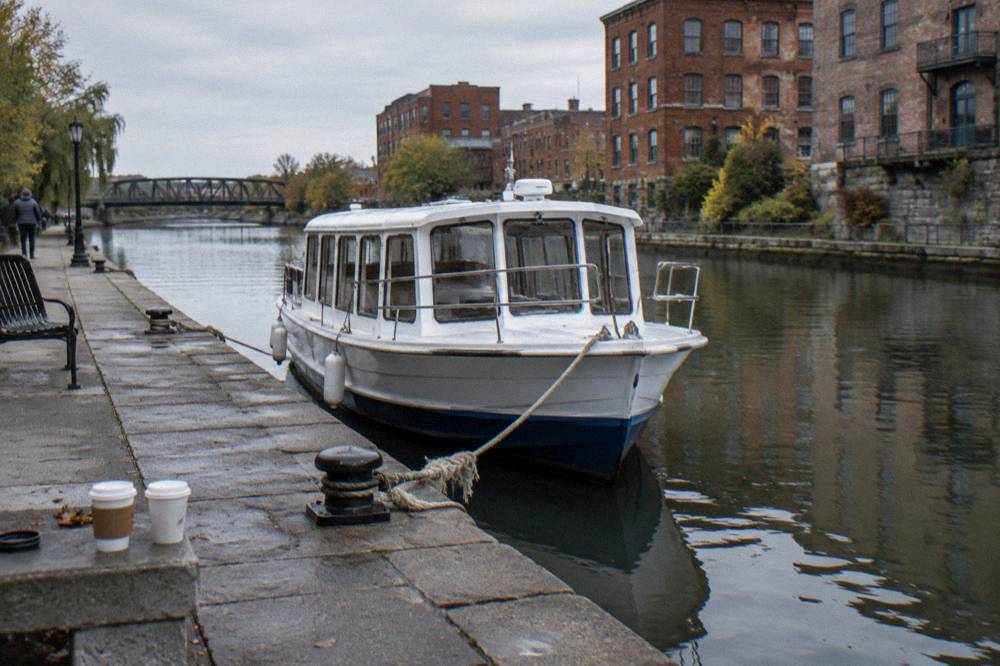
Want to see the surviving original with your own eyes? The Lockport cruise is the one that delivers it: the boat locks through the modern pair while the 1849 Flight of Five sits in view the whole time. Booking goes straight to the operator, so you can reserve before your travel dates are fixed.
Where Can You Still See Original Canal Stonework?
Lockport is the headline answer. The Flight of Five's restored locks 69 and 70, built in 1849 and reopened in 2014, sit between the modern locks and the Locks District Museum, and the site is free to walk. Beyond Lockport, original-era traces survive where the enlarged canal shifted course, and the heritage corridor's pages are the reliable guide to which remnants are genuinely original.
Lockport rewards a full afternoon. The Locks District Museum, between the Flight of Five and the modern locks, is open 8 a.m. to 5 p.m. daily through the canal season with no admission charge. The Erie Canal Discovery Center at 24 Church Street charges $6 for adults, $5 for seniors, AAA and CAA members and veterans, with children free alongside a parent. Both are within walking distance of the cruise dock at the Flight of Five, 210 Market Street, which is why the Lockport Locks cruise guide recommends pairing a museum visit with a sailing.
The Pittsford Sam Patch cruise guide covers a different kind of survival. Pittsford's Lock 32 is a modern chamber, but the village around it, with its packet boat landing at Schoen Place, preserves the commercial landscape the original canal created. The same is true across the canal corridor: the towns the 1825 canal built are the most visible survivors of all, a point explored in more depth in our piece on the most scenic part of the Erie Canal.
Be careful with claims elsewhere. Plenty of canal-side walls, aqueduct piers and towpath segments get described as original by local brochures when they date from later enlargements rather than 1825. The Flight of Five is the exception with paperwork: the restored locks are documented 1849 structures, which is why heritage sources single it out. When a site is uncertain, treat it as old canal infrastructure rather than first-generation canal. Everything else covered here is indexed on Erie Canal Boat Tours.
Fairport makes a good second stop for the same reason. The Colonial Belle, a boat launched in 1961 that celebrated its 65th launch day in 2026, sails from Packett's Landing past lift bridges and lock walls that have been rebuilt many times over the canal's life, yet the village itself grew entirely around the waterway. The Fairport Colonial Belle guide details those sailings, from $36 per adult for a two-hour cruise with no lock, up to a three-hour version that does pass through a lock.
Does The Erie Canal Still Carry Boats?
Yes, and not only pleasure boats. The 2026 navigation season ran May 15 through October 14 with no tolls or fees for recreational use, standard lock hours of 8 a.m. to 6 p.m., and extended hours to 9 p.m. at select locks including Lockport and Pittsford during the peak season. Commercial traffic is light today, but locks, lift bridges and staffed lock operators work the full season.
The canal is a live system, not a museum piece. The Canal Corporation's alert pages post a steady stream of notices about lock repairs, lift bridge work and inspections, which is itself evidence of a working waterway. Locks are staffed, boats are waited on, and the season opens and closes on published dates, the 202nd consecutive year in 2026. If you want the deeper mechanics of how the chambers operate, our article on whether the locks still work covers it in detail.
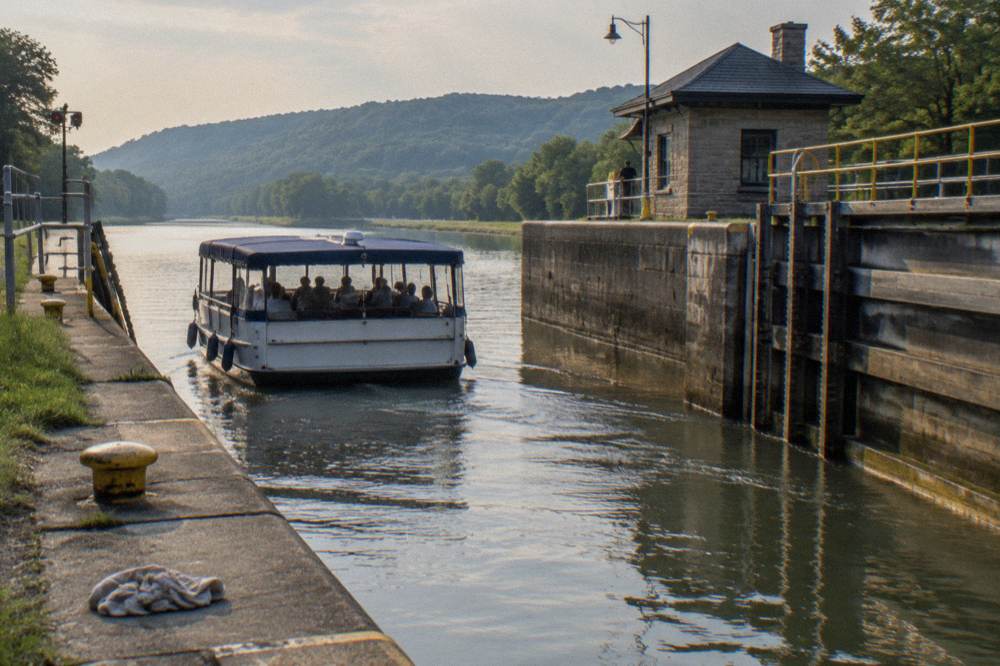
Passenger cruises are the easiest way for a visitor to ride a working lock. The Sam Patch out of Pittsford runs 90-minute cruises through Lock 32 from $30 per adult, with a 4.4 rating across 180 reviews on the operator's listing. The boat returns for the 2026 season with major upgrades, per the operator's home page.
In the Mohawk Valley, Erie Canal Cruises runs the Lil' Diamond II out of Herkimer through Lock 18 at Jacksonburg, from $29 per adult, with a 4.8 rating across 1,633 reviews. It is the only canal cruise in the Mohawk Valley, and its weather-protected vessel sails rain or shine.
You can also captain a boat yourself. Erie Canal Adventures, the former Mid-Lakes Navigation under a name adopted in 2019, rents self-skippered canal boats from Macedon with training included, from $2,770 per private boat for three nights, fuel, tolls and equipment included. The rental fleet is the closest a modern traveler gets to using the canal the way packet operators once did, as a place to live aboard for a few days. The canal boat rental guide walks through the options.
The land side of the canal survives too. The Canalway Trail network runs 423.7 miles, with the Erie Canalway Trail itself covering 360.3 miles from Buffalo to Albany as part of the 750-mile Empire State Trail, so a cyclist can trace nearly the whole surviving route on the old towpath line. The Canalway Trail and bike guide covers closures and detours, including a Utica Harbor section closed for shoreline work through December 31, 2026.
Planning around the season matters more than most visitors expect. Because the waterway closes between mid-October and mid-May, a cruise, a rental or a lock crossing only works inside that May 15 to October 14 window, and the late-season lock schedule means a September trip offers longer daylight on the water than an October one. Boaters moving between Buffalo and Albany should also budget for the sheer number of chambers on the Erie route, since 35 of the 57 locks in the New York State system sit on this canal alone.
The scale of the modern channel explains why the experience feels compact compared with the original. Today's route runs 338 miles, shorter than the 1825 line because later enlargement straightened the path, so a full transit touches fewer miles than the first boats did even as it passes through more of the surviving infrastructure. At Lockport, the 1849 Flight of Five locks 69 and 70, restored and reopened to the public in 2014, sit within reach of the locks that still carry traffic, letting a visitor stand between the working waterway and its restored predecessor in a single stop.
Common Questions About The Erie Canal Today
Does Any Part Of The Erie Canal Still Exist?
Yes. The canal operates today as a 338-mile waterway from Waterford to Lake Erie, running May 15 to October 14 in 2026. Much of it follows the original 1825 route in enlarged form, and original structures like Lockport's restored Flight of Five locks from 1849 still stand beside the working canal.
How deep is the Erie Canal now?
The modern canal is 12 to 23 feet deep and 120 to 200 feet wide, compared with the original 1825 channel's 4 feet of depth and 40 feet of width. Our article on the canal's present depth covers the full comparison.
Is the original 1825 canal still visible anywhere?
Yes, most clearly at Lockport, where the restored Flight of Five locks 69 and 70, dating from 1849, sit next to the modern Locks 34 and 35. Elsewhere, original-era traces survive where the enlarged canal shifted course, though many walls labeled original actually date from later enlargements.
Can you still travel the Erie Canal by boat?
Yes. The canal is open to recreational boats with no tolls in 2026, passenger cruises run at Lockport, Pittsford, Fairport, Rochester and Herkimer, and self-skippered rental boats are available from Macedon. The season runs May 15 to October 14.
Do the locks on the Erie Canal still work?
Yes, all of them. The Erie Canal carries 35 working locks, staffed daily from 8 a.m. to 6 p.m., with extended hours at select locks in peak season. The Canal Corporation posts ongoing maintenance notices, which is routine for a live system.
Why is today's canal shorter than the original?
The 1825 canal measured 363 miles; today's measures 338. The enlargements of the decades after opening straightened bends out of the route, so the modern channel covers the same territory with fewer miles.