Erie Canal History: How The 363 Mile Waterway Was Built And What Remains
Authorized on April 15, 1817, and opened eight years later in 1825, the Erie Canal was the biggest public works project the United States had ever attempted. Here is how it was built, what it cost, and what is left to see.
Short answer
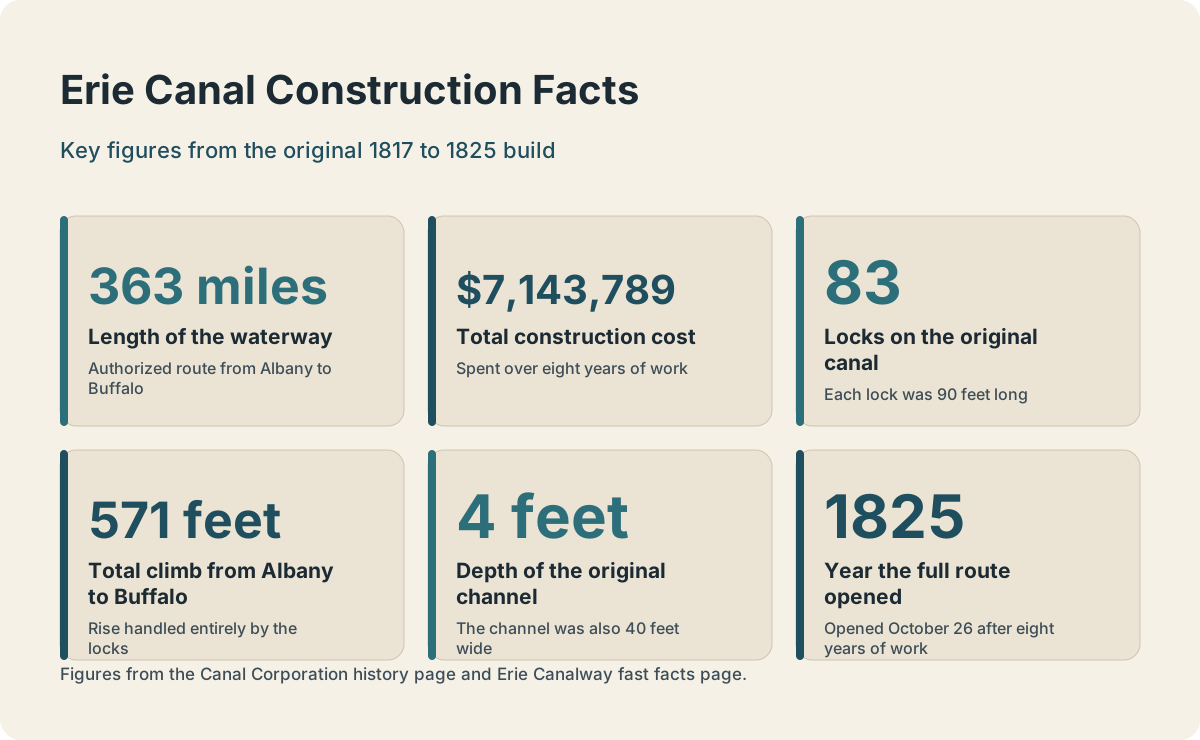
The Erie Canal was authorized on April 15, 1817, and construction started that year in Rome. The original canal ran 363 miles, was 4 feet deep and 40 feet wide, with locks 90 feet long, and opened in 1825 with 83 locks at a cost of $7,143,789. Today's canal is 338 miles from Waterford to Lake Erie with 35 locks.
The Erie Canal was authorized on April 15, 1817, when New York State committed roughly $7 million to a 363 mile, 40 foot wide waterway that critics dismissed as madness. Work began that same year in Rome, and eight years later the canal opened with 83 locks and a price tag of $7,143,789. It was dug largely by hand, by men who had never built anything like it, and it turned New York City into the commercial capital of the country. This guide walks through the whole story, then and now, and points to the places where you can still stand next to working locks from the era. The easiest way to do that is on the water, and Erie Canal Boat Tours covers the cruises that pass through locks at Lockport, Herkimer and Pittsford today.
How The Erie Canal Was Built
Construction started in Rome on July 4, 1817, and the full 363 mile route opened on October 26, 1825, after eight years of work that cost $7,143,789. The original channel was 4 feet deep and 40 feet wide, its 83 locks were 90 feet long, and the route climbed 571 feet between Albany and Buffalo, an engineering problem no American had solved before.
The idea was not new when the state finally acted. Canal proposals for connecting the Hudson River to the Great Lakes had circulated for years before the authorization, but the scale frightened investors and the federal government declined to fund it. New York went alone. The official Canal Corporation history page records the authorization of April 15, 1817, for a 363 mile, 40 foot wide waterway, and the groundbreaking in Rome that summer.
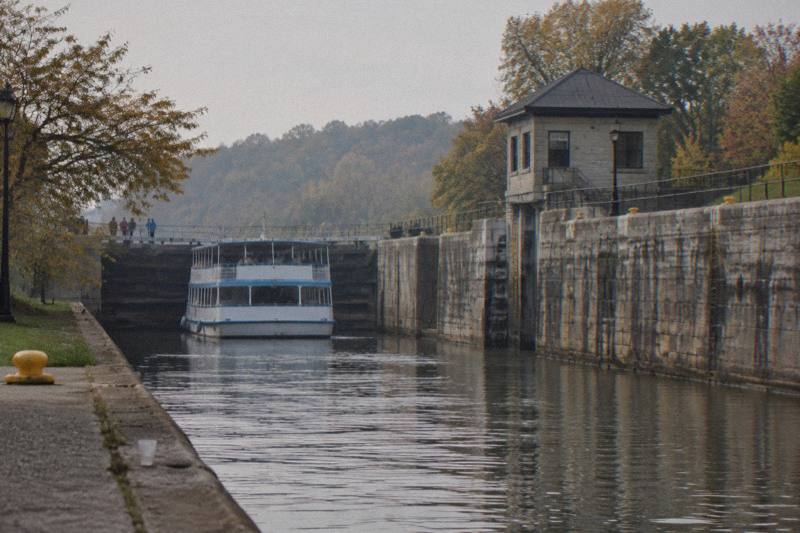
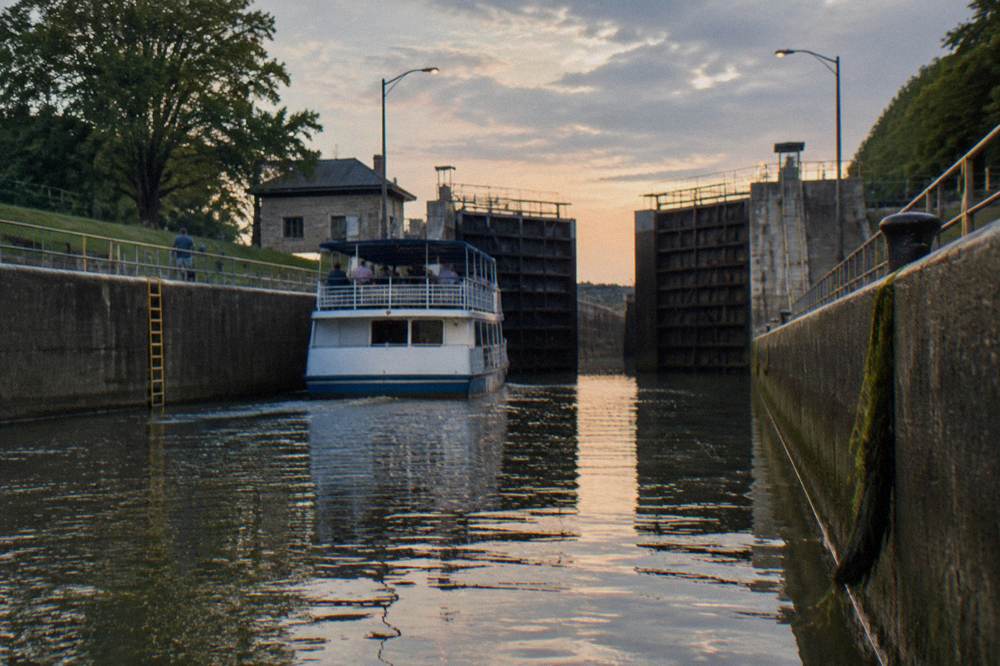
The workforce deserves more credit than it usually gets. There were no trained civil engineers in the United States when digging began, so the project trained its own. Surveyors learned on the line, and judges of local courts spent their summers staking out routes. Laborers, many of them Irish immigrants and local farmhands, cut trees, pried stumps and dug clay with spades for roughly a dollar a day. When the route hit the Niagara Escarpment near Lockport, crews blasted through limestone to create the cut that still defines that town, and built the Flight of Five, a staircase of five locks that lifted boats up the escarpment. Two of those 1849 locks, numbered 69 and 70, were restored and reopened in 2014, and you can walk beside them today.
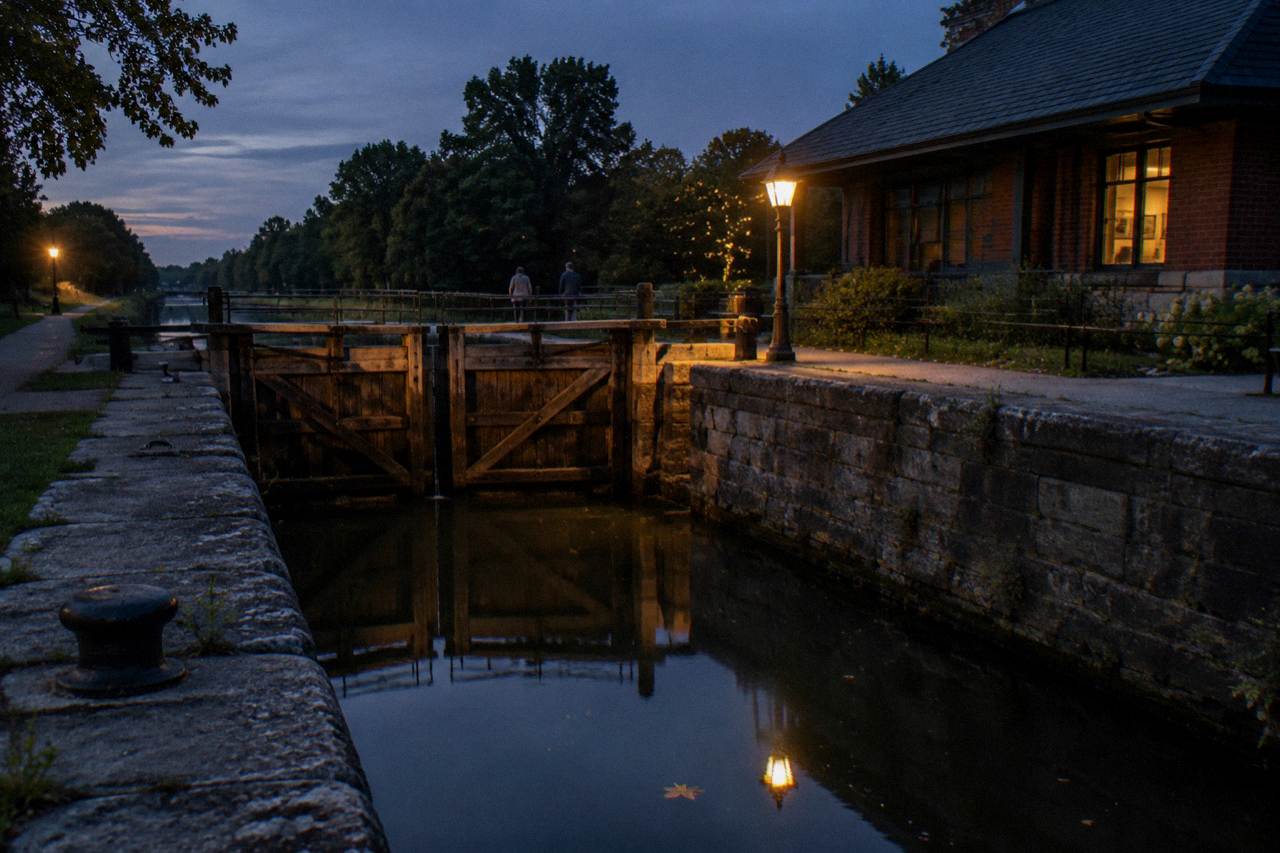
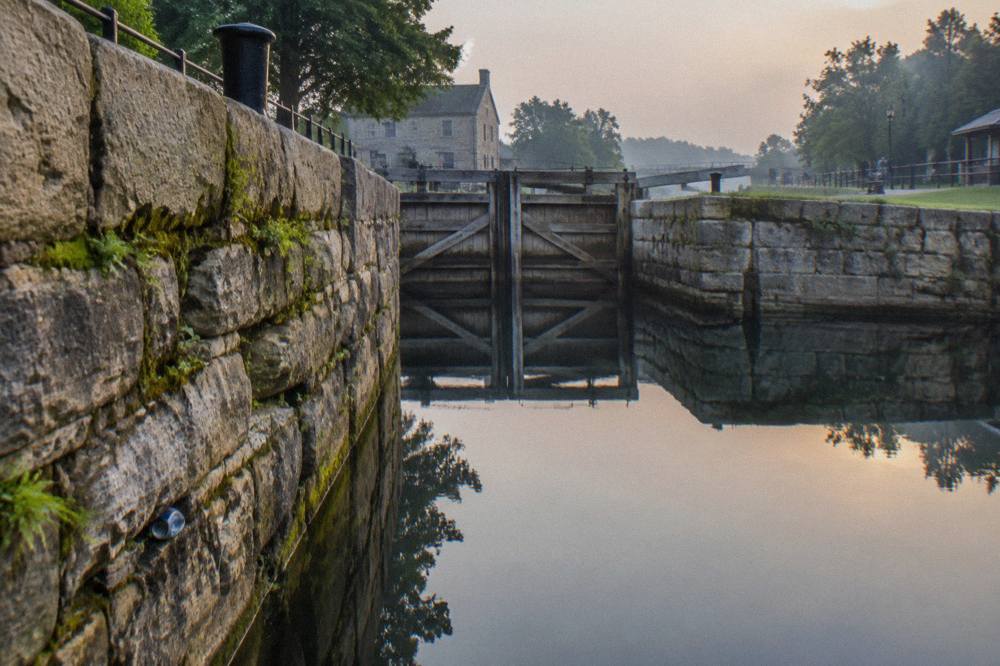
The locks solved the central problem. Water does not flow uphill, and the route from Albany to Buffalo rises 571 feet in total, per the Erie Canalway fast facts page. A lock is a stone or concrete chamber with gates at both ends: a boat enters, the gates close, water is let in or drained out, and the boat rises or falls to the level on the other side. The original locks were 90 feet long, sized for the packet boats of the day. The whole system of 83 locks let a barge climb the escarpment, cross the level center of the state and descend to Lake Erie.
When the canal opened in 1825, Governor DeWitt Clinton rode the length of it on the packet boat Seneca Chief and poured a barrel of Lake Erie water into New York Harbor in a ceremony called the Wedding of the Waters. Freight tolls repaid the construction debt within a decade. The canal was enlarged twice over the decades that followed, and much of the route was eventually rebuilt as the New York State Barge Canal, the deeper, wider waterway that boats use now.
Why Is The Erie Canal Called Clinton's Ditch
The nickname Clinton's Ditch came from the canal's political opponents, who mocked Governor DeWitt Clinton's plan as an expensive ditch through the wilderness. Clinton championed the project for years, pushed the 1817 authorization through the legislature, and led the 1825 opening ceremonies, so his enemies' insult stuck to the canal he built. The history pages record his role plainly, and the slur became a badge of honor once the tolls rolled in.
Clinton was the canal's chief advocate when advocating for it was politically risky. He had promoted internal improvements as mayor of New York City and then as governor, and he faced a legislature that doubted a 363 mile ditch could ever pay. Critics called it Clinton's Big Ditch, or simply Clinton's Ditch, and the name survived long after the argument was settled. Tolls erased the debt, the canal paid for itself many times over, and towns that had mocked the project were soon begging for a branch line.
The mockery is worth remembering because it explains the canal's place in American politics. The federal government refused to help, so New York issued its own bonds. When the project succeeded, other states scrambled to copy it, digging canals that mostly failed. Clinton, who was between terms as governor when digging began and returned to office for the opening, became the public face of a new idea: that a government could borrow, build and repay. The insult his opponents coined now appears on historical markers without a trace of the sneer.
The story is easier to picture on the ground than in a book. At Lockport, the 2-Hour Lockport Double Locks Cruise from Lockport Locks & Erie Canal Cruises passes Locks 34 and 35, the double set the operator calls the only one of its kind on the Erie Canal, right beside the restored Flight of Five that Clinton's engineers built. It carries a Tripadvisor-scope rating of 4.8 across 865 reviews, and tickets run from $26 per adult.
For a different window on the same history, the 90-Minute Mohawk Valley Lock 18 Cruise from Erie Canal Cruises in Herkimer carries a 4.8 rating across 1,633 reviews, with tickets from $29 per adult, and the 90-Minute Pittsford Lock 32 Cruise from Rochester By Water starts at $30 and passes through a working lock in a village that grew up around the waterway.
What The Canal Cost And What It Delivered
The original canal cost $7,143,789 and opened in 1825 with 83 locks along 363 miles. It cut freight costs so sharply that New York City overtook Boston and Philadelphia as the nation's port, and the tolls repaid the construction debt years ahead of schedule. The state's investment is still returning dividends as tourism: the waterway and its trail now draw visitors rather than freight.
The numbers from the state's own history pages are stark. Before the canal, moving a ton of goods from Buffalo to Albany by wagon took weeks and cost more than the goods were worth in many cases. After 1825, the same ton moved by canal boat in days at a fraction of the cost. Wheat, lumber, salt and passengers filled the packet boats, and villages at every lock turned into towns. Rochester milled flour, Syracuse boiled salt, and Buffalo became the gateway to the West.
The canal also changed what ordinary people could own. Settlers heading west rode the canal to Ohio and beyond, and manufactured goods from the coast traveled back with them. The population of the canal corridor grew faster than anywhere else in the country during the decades after opening. When railroads arrived, the canal kept operating alongside them, and the eventual rebuilding as the Barge Canal gave it a second life with concrete locks 310 feet long, electric machinery and a channel built for powered vessels rather than mules.
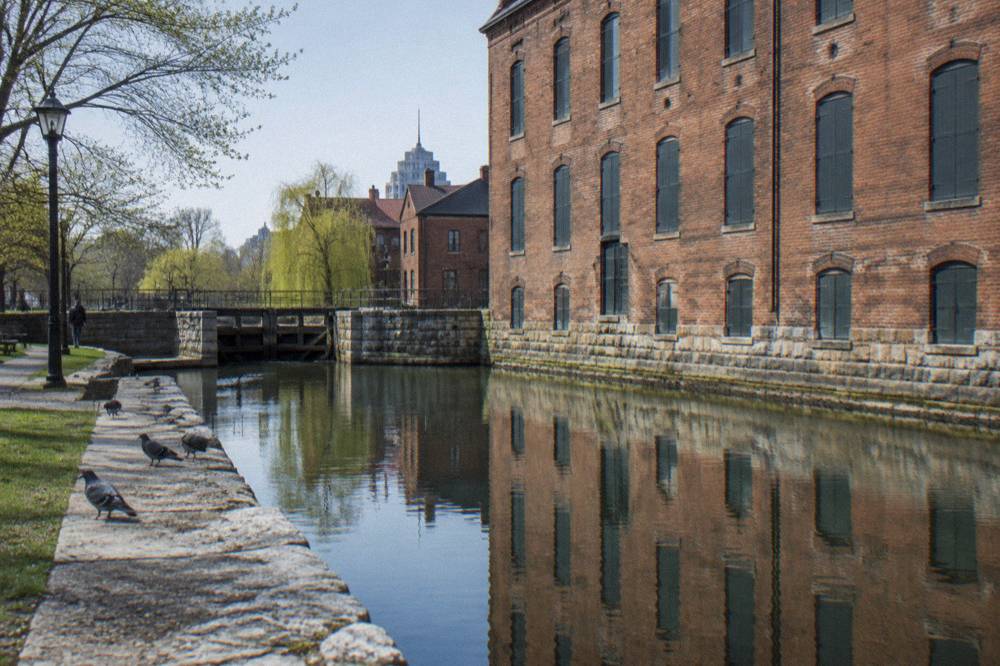
That second canal is the one running today, and the 2026 navigation season runs May 15 to October 14 according to the Canal Corporation's boating hours page. There are no tolls or fees for recreational use, and standard lock hours are 8 a.m. to 6 p.m. daily, with extended hours to 9 p.m. at select locks including Lockport's E-34 and E-35 and Pittsford's E-32 during the peak season.
Seeing a lock work is the single best way to understand what the builders achieved, and Lockport is the most dramatic place to do it, since the modern locks lift boats a combined 49.1 feet per the official guidebook, though the cruise operator rounds the figure to 50 in its own narration.
Then And Now: How Today's Canal Compares
The original 1825 canal was 363 miles long, 4 feet deep, 40 feet wide, with 83 locks 90 feet long. Today's Erie Canal runs 338 miles from Waterford to Lake Erie, is 12 to 23 feet deep and 120 to 200 feet wide, with locks 310 feet long, and carries 35 locks on the Erie itself, 57 across the whole New York canal system.
The comparison is the clearest way to grasp two centuries of rebuilding. Nothing of the 1825 channel survives as a working waterway in most places; the Barge Canal rebuilding often followed the rivers the original avoided, using the Mohawk and Seneca as impounded sections. But the route's logic, Albany to Buffalo by the gentlest available grade, is unchanged, and the 571 feet of climbing is still done by locks, just far fewer and far larger ones.
| Measure | Original canal (1825) | Today's canal |
|---|---|---|
| Length | 363 miles | 338 miles, Waterford to Lake Erie |
| Depth | 4 feet | 12 to 23 feet |
| Width | 40 feet | 120 to 200 feet |
| Locks | 83 | 35 on the Erie, 57 system-wide |
| Lock length | 90 feet | 310 feet |
| Elevation change | 571 feet, Albany to Buffalo | 571 feet, unchanged |
| Cost | $7,143,789 | Rebuilt as the Barge Canal |
The depth figure explains the change in traffic. A 4 foot channel could float a flat packet boat carrying perhaps 30 tons. A 12 to 23 foot channel floats tugboats pushing barges, and locks 310 feet long take vessels longer than the entire lock chambers of 1825 stacked three times over. Recreational boats, including the cruise vessels and the rentable Lockmaster canal boats, use the same chambers as commercial traffic, which is why a modern cruise can share a lock with anything from a kayak to a work barge.
The lock count tells the same story in reverse. Eighty-three small locks meant constant stops in 1825. Thirty-five locks on today's Erie, each handling a much greater rise or fall, mean a cruise like the Lockport trip can spend most of its two hours on open water and still pass a double lock. The Erie Canalway locks page carries the current counts for anyone who wants to check the arithmetic.
A Timeline Of The Erie Canal
The canal's key dates run from authorization on April 15, 1817, through the Rome groundbreaking that summer, the October 1825 opening with the Seneca Chief and the Wedding of the Waters, the later enlargements, the 2000 creation of the Erie Canalway National Heritage Corridor, and the 2025 bicentennial, which is now part of the canal's own history.
| Year | Event |
|---|---|
| April 15, 1817 | New York authorizes the canal, roughly $7 million for a 363 mile, 40 foot wide waterway |
| July 4, 1817 | Construction begins in Rome |
| October 26, 1825 | The canal opens after eight years; Seneca Chief carries Governor Clinton to the Wedding of the Waters in New York Harbor |
| 1849 | The Flight of Five locks at Lockport is built; its locks 69 and 70 reopen after restoration in 2014 |
| 2000 | Congress establishes the Erie Canalway National Heritage Corridor, 524 miles across 23 counties |
| 2014 | Lockport's restored Flight of Five locks 69 and 70 reopen |
| 2025 | Bicentennial of the opening, with the official bicentennial programs |
Two of those dates matter more than the rest for visitors. The 2000 Heritage Corridor designation, recorded on the National Park Service's Erie Canalway page, put 524 miles of canal corridor across 23 counties under a federal preservation and interpretation program, which is why the museums, trail networks and restored lock sites exist in their current form. And the 2014 reopening of Lockport's locks 69 and 70 means the 1849 Flight of Five is now walkable beside the modern locks, one of the few places where you can see both generations of canal engineering in a single glance.
The bicentennial in 2025 marked the 200th anniversary of the opening, and the state's bicentennial pages describe the celebration and its programs. The canal itself marked a quieter milestone in 2026: its 202nd consecutive navigation season, which the Canal Corporation lists alongside the season dates on its boating hours page.
Where To See Erie Canal History Today
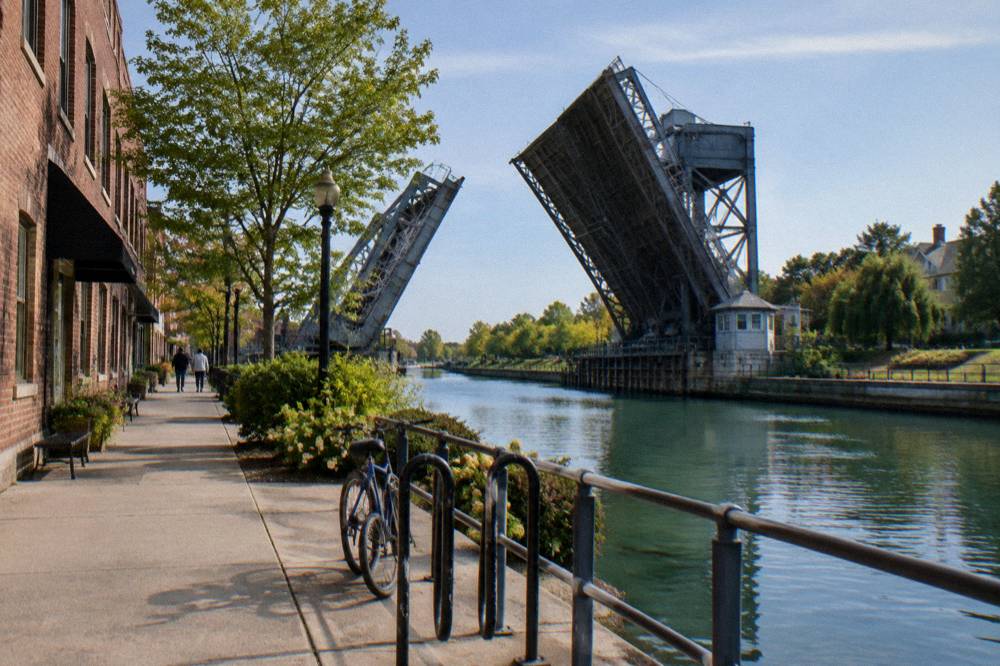
The best places to see canal history in person are Lockport for the Flight of Five and the double locks, Herkimer for Lock 18 in the Mohawk Valley, Pittsford and Fairport for working locks and lift bridges, and Syracuse for the Erie Canal Museum, which is open daily with pay-what-you-wish admission. Cruises at Lockport, Herkimer and Pittsford pass through working locks, which is the fastest way to understand the engineering.
History along the canal is not behind glass. Most of it is still wet, still locking boats up and down every day of the season, and the towns along the route grew around their locks in ways you can still read in the street plans. The table below pairs the history with the place and the way to see it.
| Place | What to see | How to see it |
|---|---|---|
| Lockport | Restored 1849 Flight of Five locks 69 and 70 beside modern Locks 34 and 35 | 2-Hour Lockport Double Locks Cruise, from $26, or the free Locks District Museum, open daily in canal season |
| Herkimer | Lock 18 at Jacksonburg, Mohawk Valley | 90-Minute Mohawk Valley Lock 18 Cruise, from $29, from Gems Along the Mohawk |
| Pittsford | Lock 32 and the village's canal-side Schoen Place | 90-Minute Pittsford Lock 32 Cruise, from $30 |
| Fairport | A lift bridge and a lock on a village main street | Colonial Belle cruises from Packett's Landing, from $36 |
| Syracuse | The Erie Canal Museum, in a surviving weighlock building | Open daily, pay-what-you-wish admission |
| Lockport (again) | Erie Canal Discovery Center, 24 Church Street | $6 adults, kids free with a parent |
The Syracuse museum is the one stop on the list with no boat involved, and it is the only remaining weighlock building in the country, the place where canal boats were once weighed to compute their tolls. Its visit page lists daily hours and pay-what-you-wish admission, which makes it the cheapest deep dive into the canal's commercial history anywhere on the route.
For most visitors, though, the lock passage is the memory that sticks. The Lockport cruise runs daily at 12:30 and 3:00 pm through the 2026 season, May 11 to October 16, with a 10:00 am sailing added in summer, and children 4 to 10 ride for $12.50 while those under 4 are free. AAA and CAA members pay $24.50. The Herkimer cruise runs daily from May 22 to October 12 at 1 pm and/or 3 pm aboard a weather-protected vessel that sails rain or shine, with children 4 to 12 at $20 and military at $27. Pittsford's Sam Patch cruise generally runs May to October, though the operator prints no 2026 dates, so check the operator's page for sailing times.
Village cruising suits families who want history without committing two hours. Pittsford's 90-minute trip through Lock 32 costs from $30 per adult, seniors and military $28, students $25, and drinks and snacks are sold aboard. There is also a lunch version, the Lock 32 Cruise With Lunch, at from $53 per adult, which pairs the same lock passage with a meal. For a deeper guide to those options, see Pittsford and Rochester canal cruises.
Fairport adds a different piece of engineering: the lift bridge on the village main street, one of the select structures with extended lock hours in peak season. The Colonial Belle, which launched in 1961 and marked its 65th launch day in 2026, runs afternoon, evening and Sunday brunch cruises from Packett's Landing from May 15 to October 30, with lock-passing trips from $44 per adult and brunch from $66. Its rating of 4.2 comes from a thin sample of 53 reviews, so weigh it accordingly. The Fairport cruise guide covers the full schedule.
Beyond the boats, the Erie Canalway Trail covers 360.3 miles of the corridor as part of the 750 mile Empire State Trail, so cyclists can ride the towpath world the mules once worked. The Canalway Trail and bike guide maps the current route, including a signed detour around the Utica Harbor Lock closure that runs to December 31, 2026. And for travelers deciding when to go, the best time for a canal boat tour explains the season windows, mid-May to mid-October, that every operator on this page works within.
Can You Still Travel The Erie Canal By Boat
Yes, and in more ways than one. Sightseeing cruises run at Lockport, Herkimer, Pittsford and Fairport through the operators listed here, and self-skippered canal boats can be chartered by the night from Macedon, with no license required after the operator's orientation. The 2026 season runs May 15 to October 14 for the waterway itself, and some cruise operators sail slightly beyond those dates on their own schedules.
The most immersive option is renting a canal boat and driving it yourself. Erie Canal Adventures, the Macedon operator that took over the former Mid-Lakes Navigation in 2019, charters self-skippered Lockmaster boats from $2,770 per private boat for three nights, with the rate covering fuel, tolls, orientation and training, cleaning, linen and full equipment. No boating license is needed; the operator trains you at orientation, and you arrive by 12:30 pm and return by 9 am. The 41 foot boats run from $3,299 and The Harriet, with a queen bed and a sitting parlor, from $3,399, all for three nights, with New York sales tax added at booking. The canal boat rental guide walks through the whole process.
Whether you ride for 90 minutes or three days, you are using the same system the 1817 builders sketched: a surveyed route, a controlled depth, and locks that lift and lower. The mules are gone and the packet boats are museum pieces, but the Wedding of the Waters is still running, one lock chamber at a time.
Common Questions About Erie Canal History
When was the Erie Canal built?
Authorized on April 15, 1817, with construction starting that summer in Rome, the canal opened on October 26, 1825, after eight years of work. It cost $7,143,789 and stretched 363 miles with 83 locks.
Why is the Erie Canal called Clinton's Ditch?
Opponents of Governor DeWitt Clinton mocked his canal plan as an expensive ditch through the wilderness. Clinton championed the project, pushed the 1817 authorization through the legislature and led the 1825 opening, and the insult became a badge of honor once tolls repaid the construction debt.
How deep is the Erie Canal now?
Today's canal is 12 to 23 feet deep and 120 to 200 feet wide, with locks 310 feet long. The original 1825 channel was only 4 feet deep and 40 feet wide with 90 foot locks.
How many locks does the Erie Canal have?
The Erie Canal has 35 locks today, out of 57 across the entire New York State canal system. The original canal had 83 locks when it opened in 1825.
How much did the Erie Canal cost to build?
The original canal cost $7,143,789, authorized as roughly $7 million on April 15, 1817. Freight tolls repaid the construction debt within about a decade of opening.
Does any part of the original Erie Canal still exist?
Yes. The restored Flight of Five locks 69 and 70 at Lockport, built in 1849 and reopened in 2014, can be walked beside today, and the Erie Canal Museum in Syracuse occupies a surviving weighlock building. Most of the working waterway, however, is the later Barge Canal rebuild.